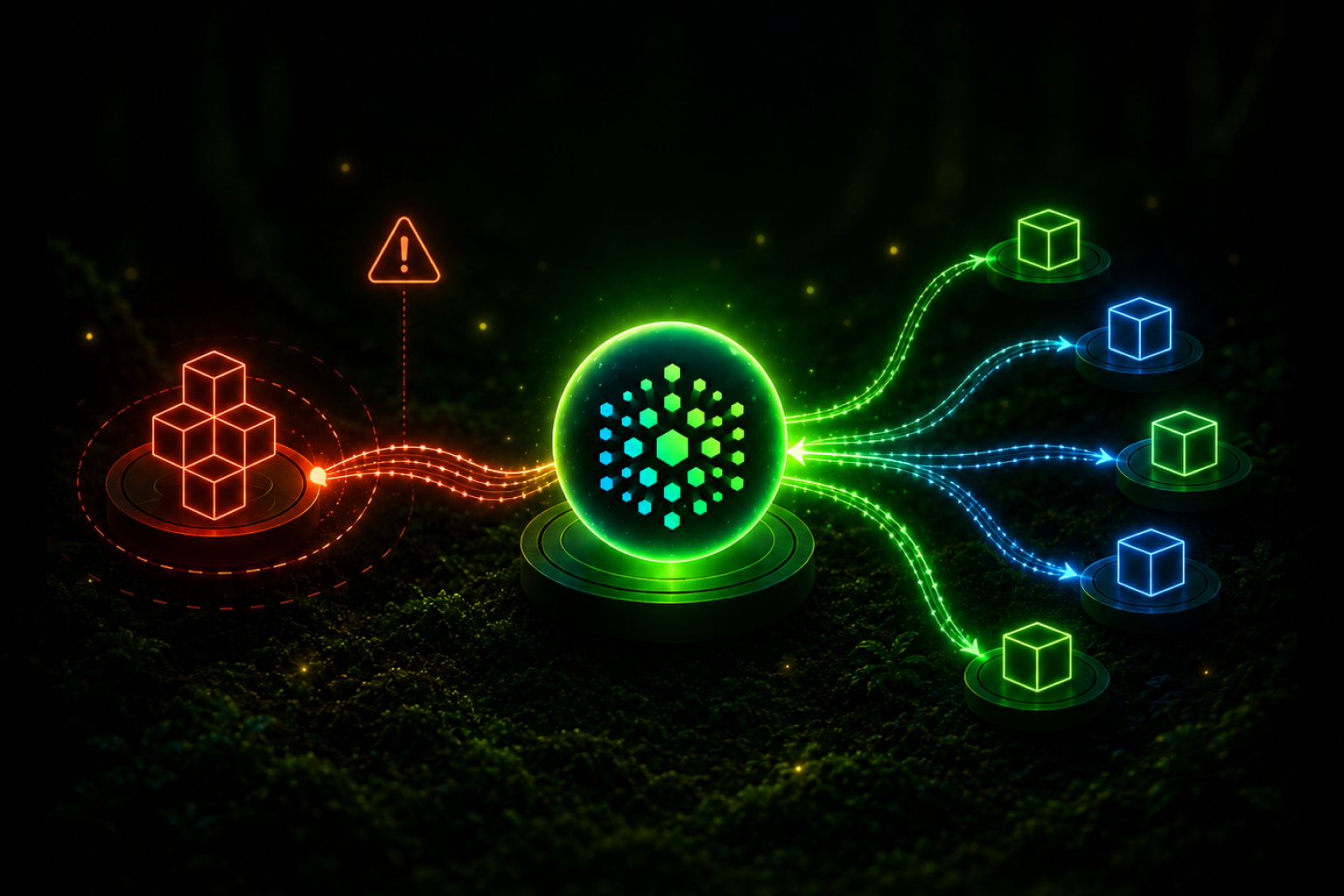
The Silent Technical Failure Behind Institutional Staking Risk
Reading Time - 13 min

When you lock up capital to generate staking yield, the first risk you actually face is a quiet one. Call it institutional staking risk, hiding in plain sight.
It sits outside the alerts and dashboards most teams rely on to know something is wrong.
We call it the silent technical failure.
At institutional scale, it is not a rounding error. It is tens or hundreds of thousands of dollars in missed yield, accumulating in the background while everything on the surface looks fine.
This is the second piece in our series on the risks institutions face when staking at scale.
In this article, we’re going to walk through:
- What a silent technical failure actually is
- What causes it on Solana
- What it costs
And how we built Polli to catch it before it costs you anything meaningful.
What Is a Silent Technical Failure?
A silent technical failure is a validator degrading or going offline without triggering the alerts or slash records that would normally flag a problem. It stops performing the way it should. Unless someone is watching closely, nobody notices until the damage is done.
The word “silent” describes the timing more than the mechanism: you find out what happened once it has already cost you.
On Solana, that gap is wider than on most networks because Solana has no slashing. Institutions got used to watching out for slashing, because that’s the risk that shows up on other chains.
That risk doesn’t exist on Solana as of now. But what actually costs money here works the opposite way: it leaves no penalty record and fires no alert.
Causes of Silent Technical Failures
What causes a silent technical failure in the first place? It usually comes down to one of two things, and the first is upkeep.
Validator Upkeep
Staying at the top of validator performance takes real, ongoing upkeep. Very few operators stay current. It comes down to:
- Choosing the best software
- Running the latest client
- Watching your own performance day to day.
Most validators fall short on at least one.
Correlated Infrastructure Failure
The other major cause is structural. It has nothing to do with any operator’s mistakes. It is about what sits underneath the validator.
Validators that look completely independent by name can run on the same site, in the same city, or behind the same routing table.
When the shared thing fails, every validator behind it goes down together, for the same reason. From the outside, it does not look like a coordinated event. It looks like several validators are quietly failing at once.
Institutions spreading stake across validator names often believe they have “diversified.” On Solana, that belief does not survive the hosting data. Based on Polli’s internal data, one hosting operator carried 27.9% of all staked SOL across 95 validators, for four months.
Spreading stake across ten validator names is not the same as spreading it across ten pieces of infrastructure. That gap is where correlated failure hides.
What a Slow Discovery Actually Costs
In June 2026, Polli recorded nine validators run by a single operator at one site in Frankfurt going delinquent in the same epoch. Together they carried 395,874 SOL, nearly two-thirds of the network’s entire delinquent stake that epoch.
Across every location the operator runs, 10 of its 11 validators were down. The site stayed at 100% of its fleet delinquent for five consecutive epochs, about ten days.
Delinquent stake at that site then collapsed after Jun 30, 2026 while every validator there was still down. That was not recovery. That was delegators finally noticing and withdrawing about a week in, after paying for the week.
The bill for waiting was 3 to 15 basis points in missed epoch rewards, plus another 6 basis points to redelegate. That’s 9 basis points at best, 21 at worst, on a failure that was visible in the data from day one.
On a $100 million allocation, even the best case, 9 basis points, comes to $90,000, for a problem the data flagged from the very first epoch.
What Correlated Failure Costs When It Happens Fast
On August 12, 2026, a routing failure at one hosting operator took roughly 29% of all staked SOL offline across two continents at once, for up to 33 minutes, bringing the network close to the threshold at which Solana stops finalizing transactions.
Nothing physical broke. One configuration change did it all.
Our own monitoring ran fifteen minutes after service was restored and reported a quiet day. Not because it doesn’t work well, but because 33 minutes is about 1% of a 50-hour epoch. By then, there was nothing left to see.
If a system built to watch validators on an ongoing basis saw nothing, a quarterly review would have easily missed this.
Two Speeds, Two Different Answers
Slow failures last days, which in the June case cost 9 to 21 basis points. They show up in the first sample, and moving away from them is worth the cost.
Fast failures last minutes and cost almost nothing. The August event cost about 0.03 basis points, against 6 to redelegate. Two hundred times the damage to escape something already over.
Neither speed can be caught in real time before it’s already happened.
What you can control is exposure: capping how much of an allocation sits behind any one shared dependency before the failure hits. Institutions often confuse detection with prevention, buying faster alerts for a problem alerting alone cannot solve.
MEV (Maximal Extractable Value): The Risk You Can Actually See On Chain
Silent technical failure is not the only place yield goes missing unnoticed. MEV distribution is fully verifiable on-chain and tells a similarly uneven story.
Out of 28.9% of all staked SOL earns no MEV at all. Let’s break it down:
- 26.5% sits with validators that run Jito and keep 100% of it.
- 2.4% with validators not running Jito.
Network-wide MEV distribution: 68.3% reaches delegators, validators keep 28.6%, and the Jito protocol takes 3.1%.
MEV is worth about 14 basis points a year on Solana. A delegator at one of those validators earns none of it, which against a base staking yield of ~5% means giving up 2.7% of their total return.
What Should You Check in Your Own Portfolio?
Validator-level metrics miss most of this, because the correlated risk sits one layer below the validator.
- Ask every validator who hosts them, in which city, and on which autonomous system.
- Map the set by operator and city rather than by validator name, rolling operators up by company.
- Set an exposure cap per operator and a separate cap per city, since one does not cover the other.
- Ask whether the validator has tested automatic failover to a second location.
- Treat an unanswered hosting question as a red flag on its own.
Most institutions won’t staff someone to track this around the clock, chasing hosting disclosures and recalculating exposure every time an allocation shifts.
How Polli Handles It
We score validators continuously, not through periodic review cycles, using signals that move before an outage does. Uptime tells you a validator has already failed.
Vote success rate, commission changes, and stake trajectory tell you it is drifting. Stake trajectory separates an outage from a validator quietly winding down, which look identical in a delinquency flag.
What matters more than watching is knowing when watching turns into moving, and that decision is priced in advance.
Take the two events above.
- In June, the signals pointed to something extended rather than a brief hiccup, so the allocation moved ahead of the ten-day window, and the 9 to 21 basis points it cost everyone who waited.
- In August, the correct action was to do nothing because reacting to a 33-minute interruption would have cost two hundred times what it did.
A system that moves on every alert destroys more yield than the alerts do, and invisibly, because switching costs never show up on a dashboard as a loss.
For the failures nobody can catch in time, the control is exposure rather than speed. We map delegation sets by operator, autonomous system, and city, so you know how much can go dark at once before the event, not after.
If you want to see where your own allocation sits, we can produce a concentration map of your current delegation set on request.
Frequently Asked Questions
What happens when a staking validator goes offline?
The validator stops earning rewards for the period it’s down, and delegated stake earns nothing during that window. This is typically a yield loss event rather than a loss of principal.
Is staking with a large validator riskier than staking with a smaller one?
Not necessarily by size alone. The bigger risk is shared infrastructure. A validator, or a cluster of validators, running on the same hosting provider or cloud region carries correlated failure risk. One facility-level incident can take them all offline at once, regardless of how many different validator names are involved.
How much yield can an institution lose from an undetected validator outage?
On Solana, a single missed epoch costs roughly 3 basis points, covering a fully missed epoch and inflation rewards only. Outages can go unnoticed for days, and switching to a new validator adds its own cost while it reactivates. The real total scales with how long detection and reaction take.
What is name diversification versus infrastructure diversification?
Name diversification means spreading stake across different validator identities. Infrastructure diversification means making sure those validators don’t share the same facility, cloud region, or hosting provider. The first gives a false sense of safety. The second is what actually reduces correlated failure risk.
What tools help manage this risk when staking on Solana?
Effective risk management requires monitoring beyond simple uptime. That means infrastructure-level mapping of where validators actually run, continuous performance scoring across multiple signals, and automated redelegation when a validator’s risk profile changes, rather than periodic manual review.
Can silent technical failures be prevented entirely?
Not entirely. Infrastructure incidents and operator issues will always happen. What can be controlled is detection speed and how quickly capital moves once a real problem is identified. That’s the gap continuous monitoring is built to close.
Note: This material is for informational purposes only and does not constitute investment advice or a recommendation. Case examples are historical and illustrative; they do not project or guarantee future results.

August 14, 2026
August 31, 2026