
The Allocation Problem: Crypto’s Most Expensive Blind Spot
Reading Time - 12 min

Over the past decade, crypto has built something genuinely unprecedented. Proof-of-Stake networks now secure hundreds of billions in productive capital. The infrastructure to hold this capital exists. The infrastructure to deploy it intelligently does not.
That gap has a name in traditional finance: capital allocation. Institutional allocators dedicate serious resources to one question: Where should capital flow to produce the best risk-adjusted return?
In crypto, the dominant answer is still: delegate once and leave it alone.
In this article, we break down why that answer is costing the industry billions and what needs to change:
- The scale of the yield gap and why $1 billion in annual losses goes unaccounted for.
- What allocation intelligence actually means as a practice and a system.
- The three requirements that any credible allocation infrastructure must meet.
- How Lava Foundation put this into practice and what it produced.
The Scale of the Yield Gap
Using Staking Rewards data with full staking participation, the Proof-of-Stake market is estimated at $200 billion (as of June 2026), spread across Ethereum, Solana, Bitcoin, and dozens of other networks.
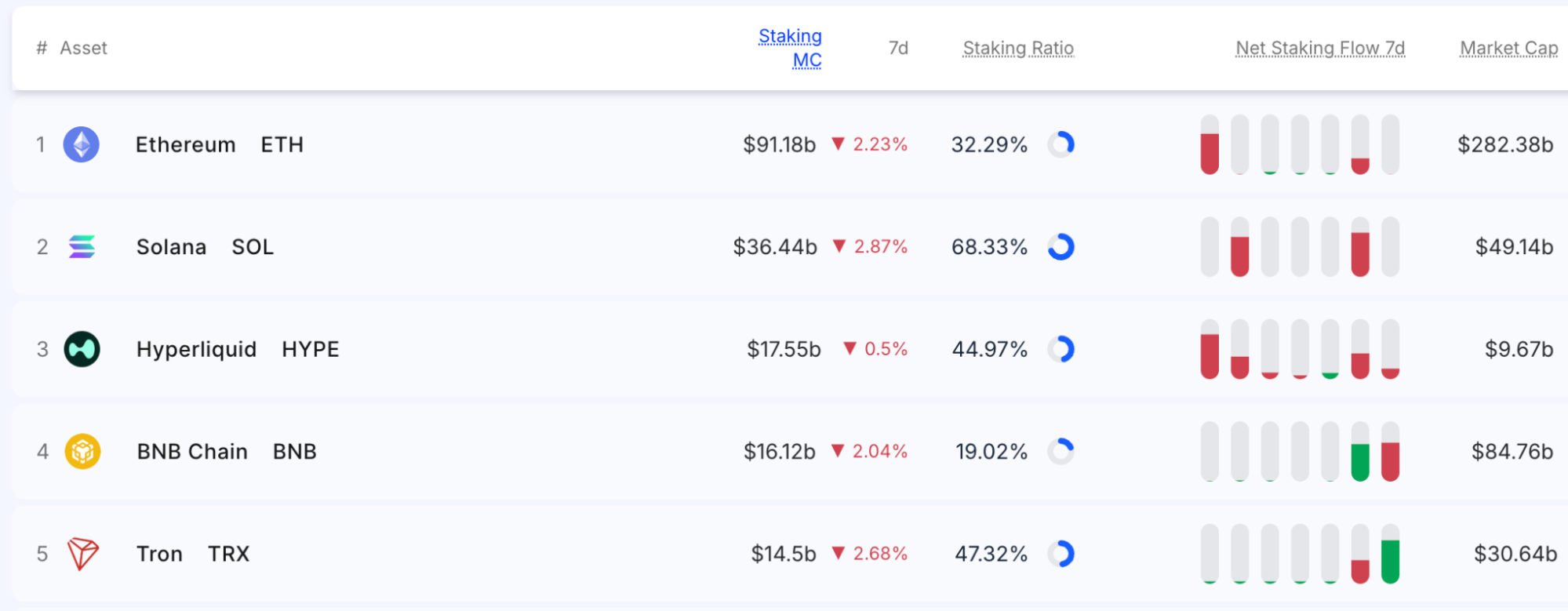
Staking allocation is the engine room of the decentralized economy, yet it is almost entirely statically allocated.
Validator performance dispersion across every major network is real and measurable.
Different validators produce different returns due to uptime, commission structures, MEV capture efficiency, and slashing risk management. The spread between top and bottom performers on a given network regularly ranges from 0.5% to 4% APR.
Apply a conservative 50 basis points allocation inefficiency to $200 billion in staked capital, and the result is $1 billion in yield left on the table per year.
Because there is no infrastructure to address it, no one is held accountable for this loss.
The Hidden Cost to Network Health
The yield loss is measurable. But the damage to the networks themselves is harder to quantify.
When capital flows toward familiar “brand names” rather than optimal performers, validator centralization accelerates. High-performing validators without massive marketing budgets remain chronically under-allocated.
According to Solana Beach, as of April 2026, the top 18 validators on Solana form a Superminority, controlling 33.4% of staked SOL.
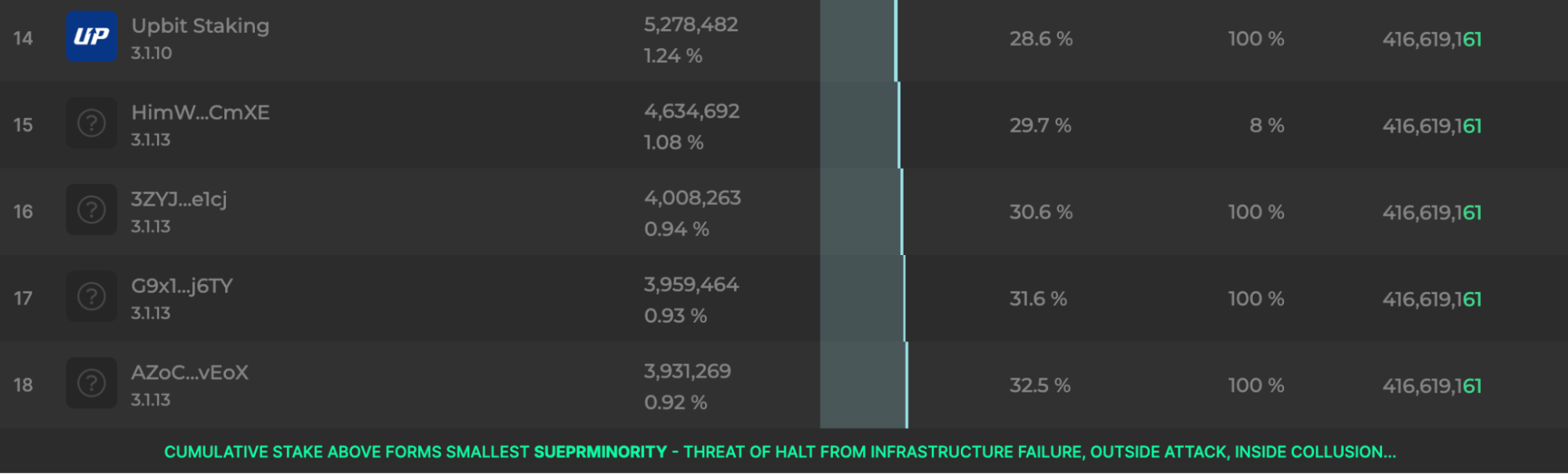
When a handful of validators control the majority of stake, the network becomes fragile. One coordinated failure and finality breaks down.
The treasuries holding the most productive capital inadvertently contribute to this fragility not by intent, but by the absence of tools that would allow them to do otherwise.
This is not a capability gap; it is an infrastructure gap.
An Architecture Constraint, Not a People Problem
Foundations managing large positions typically spend four to six months on a single cycle of validator re-delegations. They aren’t being lazy. They are being manual in an automated world.
The work is genuinely complex, which includes:
- researching performance
- evaluating changes to commissions
- coordinating execution
By the time one cycle closes, conditions have already shifted. You cannot solve a high-frequency problem with low-frequency governance.
Institutions face a different but equally structural problem.
Many players still rely on spreadsheets to track validator performance, applying a slow cadence to an asset class that moves at the speed of light. Even Morgan Stanley’s Global Investment Committee, in its October 2025 special report on cryptocurrency allocation, recommends rebalancing “preferably on a quarterly basis, or at least annually.”
Networks evolve, validator quality shifts, and reward rates change with protocol upgrades. A portfolio approach designed for slow-moving assets will chronically underperform in a fast-moving on-chain environment.
What is Allocation Intelligence?
Solving this requires a dedicated allocation intelligence layer for crypto capital.
Allocation intelligence is a delegation program that behaves like an actively managed institutional strategy rather than a wallet setting.
It is a system that treats crypto capital allocation the way institutional asset management has always treated it.
This means:
- Continuous validator intelligence built on live on-chain data.
- Policy-based allocation, in which an institution defines its objectives.
- Policies dynamically translate into delegation decisions.
Capital should move when conditions warrant it. And it requires a non-custodial architecture, full stop. Institutions will not cede custody of assets to access intelligence.
Every decision must be transparent. Every action is auditable. Custody must remain unambiguously with the capital owner.
3 Allocation Intelligence Requirements
Allocation intelligence, as a practice, requires three things working simultaneously.
-
Continuous, reportable real-time validator data
The first is continuous, real-time validator data. A live, normalized picture of every validator across supported networks:
- Uptime trends
- Commission changes
- MEV performance
- Stake concentration
- Slashing history
- Governance behavior.
The validator landscape is not static. A validator that was among the best performers six months ago may have degraded. A newer operator running exceptional infrastructure may be significantly under-allocated.
Static data produces static decisions, and static decisions are precisely what created the allocation problem in the first place.
-
Policy Setting Capability
The second is setting policy preferences. This is where the requirements of different institutional participants create real complexity, and where a one-size-fits-all approach breaks down entirely.
A foundation managing a large native-token position is balancing:
- Yield targets against decentralization commitments.
- Network-health objectives.
- Risk thresholds.
- Governance considerations specific to its role in the ecosystem.
Its allocation mandate is inseparable from its obligations to the network it helped build.
An asset manager or crypto fund has a different set of constraints: performance attribution, risk-adjusted return targets, reporting requirements, and, in many cases, a mandate that spans multiple networks simultaneously.
Optimizing across Ethereum, Solana, and Bitcoin simultaneously, with different validator economics, unbonding periods, and risk profiles on each chain, is not something a spreadsheet was ever designed to handle.
A protocol treasury faces yet another configuration: how do you deploy native token reserves in a way that actively supports the health of your own network while generating returns that fund ongoing operations?
The allocation decision here is simultaneously a financial and a governance one.
An allocation engine that optimizes for a single variable will fail all three. The system needs to support multiple objectives simultaneously and produce delegation decisions that reflect real institutional priorities rather than relying on simplified heuristics.
-
Non-custodial execution
The third requirement is non-custodial execution. It is the architectural precondition for institutional participation at any of these levels. Institutions will not hand over custody of assets to access better allocation intelligence.
The infrastructure must execute allocation decisions, including automated redelegations and reward compounding, while custody remains entirely and unambiguously with the capital owner.
These three requirements together describe something that does not yet exist as a standard infrastructure layer in crypto. Dashboards exist. Yield trackers exist. Staking services exist.
What does not exist is a system that treats capital allocation in crypto the way institutional asset management has always treated it: as a continuous, policy-driven process that adapts to changing conditions in real time.
What Allocation Intelligence Looks Like in Practice
The Lava Network provides a concrete illustration of what intelligent allocation actually produces.

Lava is a modular blockchain focused on RPC infrastructure. Like most networks at its stage, it faced a structural challenge familiar to foundations everywhere: how to actively manage a large native-token position to support network health while generating consistent returns, without the operational overhead of a full-time delegation-management function?
Working with Polli, Lava implemented a continuous, policy-driven delegation program across its validator set. The results reflected what allocation intelligence is designed to produce:
- Improved yield consistency.
- A healthier distribution of stake across the validator set
- Reduced operational burden on the foundation team.
The delegation team at the Lava Foundation described the impact directly: the program enabled them to actively manage their delegation strategy in a way that was simply not operationally feasible before.
The team added, “With Polli, Lava Network benefits from improved security, consistency, and staking mechanisms.”
For protocols operating their own treasury staking programs, the value extends further still. The ability to define allocation policies that reflect specific network health objectives, then have those policies execute automatically and continuously, turns what was previously a governance burden into a systematic program.
Stake flows to validators that meet the protocol’s own standards for performance and decentralization. The treasury becomes an active participant in network health rather than a passive holder hoping the validators it delegated to years ago are still performing.
The Bigger Shift
What is happening in staking right now is a preview of what will happen across every productive capital market in crypto: restaking, liquidity provision, lending, RWAs.
In each of these markets, as participation matures and idle capital shrinks, allocation will increasingly be the variable that separates strong performers from average ones.
The foundations, institutions, and protocols that build systematic allocation frameworks now are not just improving their current yield. They are building the operational capability that will matter most in a market where allocation is the only remaining edge. And they are contributing, directly, to the health of the networks they depend on.
Networks where capital flows intelligently will be more secure, more decentralized, and more resilient. Their yields will be more stable because they reflect actual network health rather than temporary distortions.
And the institutions allocating that capital intelligently will have been the ones who understood, earlier than most, that the goal was never to chase yield.
It was to create the conditions in which yield takes care of itself.

May 8, 2026
June 5, 2026