
What Is Allocation Intelligence? The Framework Redefining Institutional Crypto Yield
Reading Time - 10 min

Crypto’s infrastructure layer is effectively solved.
Between institutional-grade custody and robust compliance frameworks, the industry has spent the last five years figuring out how to secure assets. But as the “how” of security becomes a commodity, a gap forms in how to allocate this capital.
Most institutional stakers treat staking as a passive capital position. Staking becomes an infrastructure checkbox rather than an active financial strategy.
This passive approach has a measurable cost in lost yield.
Polli introduces a new framework that moves staking from a dormant balance sheet item to a continuously managed discipline.
This approach is called Allocation Intelligence.
When Staking is a Position, Not a Strategy
Most institutional allocators set a staking position and revisit it periodically, if at all. They select a reputable validator and pass the returns to their stakeholders. However, this approach ignores what happens on-chain and on decentralized networks.
Staking returns are a continuously changing function of validator performance, network conditions, and capital concentration.
When a staking position is left unmanaged:
- Validators Drift: Even the best validators can slip in performance or increase commissions without notice.
- Contagion Risk: Static capital remains tied to protocols even after their safety profiles change. In a market where a single exploit can drain millions within minutes, standing still makes one a target for smart-contract and cross-chain failures.
- Capital Concentrates: Capital flows toward a few dominant operators, increasing slashing correlation and degrading network decentralization.
Treating staking as a passive activity is a capital allocation failure.
To optimize risk-adjusted returns, institutions must approach their staking positions with the same rigor as they do an active trading book.
Defining Allocation Intelligence
Allocation Intelligence is the continuous, data-driven process of monitoring, routing, and rebalancing capital. These processes move to maximize risk-adjusted yield while reinforcing network health.
It is the intelligence layer that sits between institutional capital and the networks that depend on it. While infrastructure providers focus on uptime and compliance, Allocation Intelligence focuses on performance and impact.
Continuous Evaluation
Institutions manage staking using historical data. Managers look at a validator’s uptime over the last month or their current commission rate. This approach is approaching obsolescence, given how the on-chain data infrastructure has matured.
Instead of monthly manual checks, Allocation Intelligence establishes a system that indexes on-chain data every block. It tracks indicators such as missed attestations, rising skip rates, and signs that a validator’s hardware is struggling before it fails.
Because yield opportunities scatter across chains, there is a need to normalize data into a single scoring system. Allocators can then compare a liquid staking position on one chain against a restaking vault on another using the same risk-adjusted lens.
Policy-Driven Routing
Most institutions have internal mandates (e.g., “Maximize yield while maintaining a 48-hour liquidity window”). Allocation Intelligence turns these mandates into code.
Allocators define their guardrails, such as decentralization targets, maximum commission thresholds, or minimum hardware distribution across geographies.
When an event occurs and threatens the risk standards, the routing engine identifies the violation and prepares to move capital.
Yield Through Network Health
Allocation Intelligence moves beyond yield extraction, focusing on the long-term compounding of an asset’s value.
Instead of herding into the largest commission-free validators, the intelligence layer routes capital to high-performing, medium-sized operators. By spreading stake across diverse, high-performing operators, an institution protects itself from correlated slashing events. If one operator fails, the rest of the allocation remains unaffected.
Protecting the network is the most effective way to protect the principal.
Why This Matters Now: The Shift from Accumulation to Allocation
The conditions that make a dedicated allocation layer necessary or possible did not exist three years ago. However, the industry has advanced to the point where holding crypto is no longer the benchmark for institutional success.
A new market reality drives this mindset shift.
The Institutional Floodgates Have Opened
Recent regulatory milestones, specifically the Securities and Exchange Commission’s (SEC) May 2025 crypto staking guidance, have removed barriers to entry. Institutions now actively deploy capital.
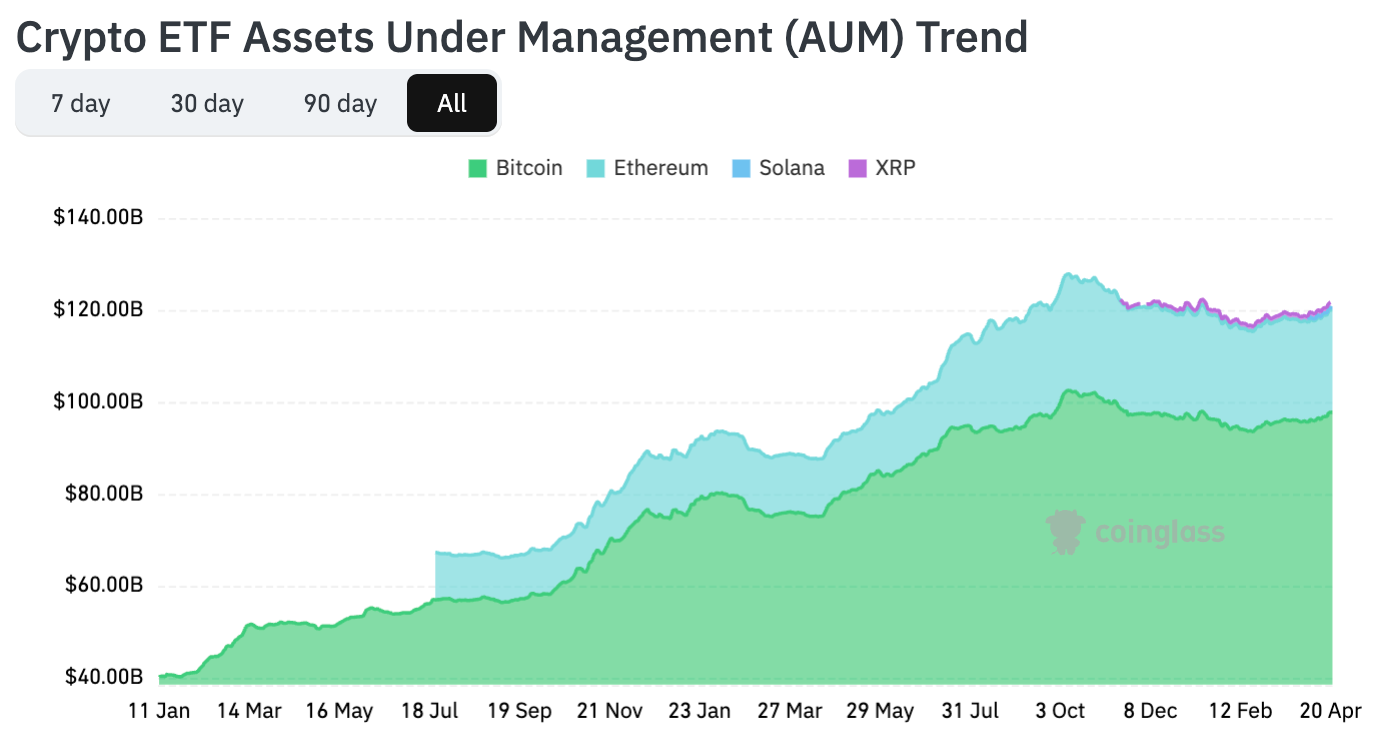
According to CoinGlass data as of April 2026, exchange-traded funds (ETFs) have attracted over $120 billion in assets. Traditional finance giants such as BlackRock and Fidelity lead the charge.
This influx of professional capital has shifted market expectations from basic network access to sophisticated performance management.
The Rising Cost of Passive Allocation
As Proof-of-Stake (PoS) networks mature, the staking environment becomes hyper-competitive.
More capital in the system means a higher density of validators, which in turn leads to greater performance variance. When dozens of operators are competing for the same block rewards, the gap between an optimized position and a passive one widens significantly.
In this environment, inertia has a price. A static allocation that ignores commission hikes, rising skip rates, or compounding opportunities widens the yield gap.
Intelligence vs. Infrastructure
Established providers like Figment and BitGo have spent years perfecting the infrastructure and compliance layers. They focus on the plumbing. Keeping nodes online, securing keys, and meeting regulatory standards.
While others manage the pipes, Polli builds the brains.
Rather than a provider that simply keeps a node running, Allocation Intelligence continuously routes capital to the most efficient and secure opportunities.
The Allocation Intelligence Stack: How It Works
Polli replaces static positions with a continuous, multi-objective management engine. This is how the Allocation Intelligence stack operates in practice:
1. Proprietary On-Chain Intelligence
Allocation starts with data.
Polli indexes yield-bearing opportunities in real time. The platform scores validators on reliability, commission efficiency, and stake concentration. This approach ensures that institutions can treat staking as capital allocation, accounting for every basis point.
2. Multi-Objective Models
Unlike retail tools, institutional allocation requires balancing competing priorities.
The engine does not just chase the highest APY; it balances yield maximization against risk thresholds and decentralization targets. It produces decisions that reflect institutional priorities.
3. Non-Custodial Execution
Institutions will not cede custody of assets to access intelligence.
Allocation Intelligence must be a guiding layer, not an intermediary. Polli’s architecture ensures that while allocation is automated, including auto-compounding staking rewards and rebalancing, the assets never leave the owner’s control.
Polli maintains this approach as it expands into other areas such as RWAs, Ethereum, and the EVM ecosystem.
The New Standard for Institutional Participation
The market has a security layer and a compliance layer. What it has lacked is an Allocation Intelligence layer.
For institutional managers, the question is no longer “Who is holding the keys?” but “Is the capital performing?”
Polli exists to ensure the answer is yes. By building the allocation layer for everything that earns on-chain, Polli is turning the structural failure of static capital into the resilience of a managed strategy.
Frequently Asked Questions (FAQs)
What is Allocation Intelligence in crypto staking?
Allocation Intelligence is a systematic operating layer that sits between capital and blockchains. It continuously evaluates, routes, and rebalances assets based on live data and institutional policy.
Who is this framework designed for?
Allocation Intelligence is built for institutions and professional allocators who hold significant on-chain positions. They need a systematic way to manage yield and risk at scale.
How is allocation intelligence different from staking-as-a-service?
Staking-as-a-Service (SaaS) is the “plumbing” of the network. It provides the nodes, hardware, and uptime necessary to participate in staking.
Allocation intelligence is the “brain” that sits atop that plumbing. It continuously evaluates the landscape to ensure capital is routed to the most efficient, secure, and high-yielding opportunities in real-time.
How does Polli’s allocation intelligence layer manage validator risk?
Polli manages risk through pre-emptive monitoring. Polli’s intelligence layer indexes real-time on-chain telemetry to identify “signatures of failure.” By identifying these red flags early, the system can trigger a rebalance to a safer operator.

April 28, 2026
April 28, 2026