
RWA Staking: How Traditional Assets Can Improve Network Security
Reading Time - 9 min
For over a decade, crypto has existed almost entirely on-chain.
From Bitcoin’s launch to the explosion of DeFi, value has existed mostly within the confines of the blockchain. Many of the industry’s efforts have focused on getting traditional finance and big institutions to buy into these digital assets.
But the boundary between digital code and physical reality is merging.
Crypto is moving into the real world, gaining representation in tangible, high-integrity assets such as U.S. Treasuries, equities, and commodities.
These real-world assets aren’t just a new trend.
We’re entering an era where the stability of the traditional economy meets the efficiency of the blockchain.
Read this article to learn about:
- What are real-world assets (RWAs)
- Which blockchains are leading the RWA push
- What current RWA staking means
- The vision for RWA staking
…and much more.
Keep on reading!
What are Real-World Assets (RWAs)?
Real-world assets are tangible or intangible assets that exist outside the blockchain but are represented as on-chain digital tokens.
Current popular RWAs include US treasuries, commodities such as Gold and Silver, and equities.
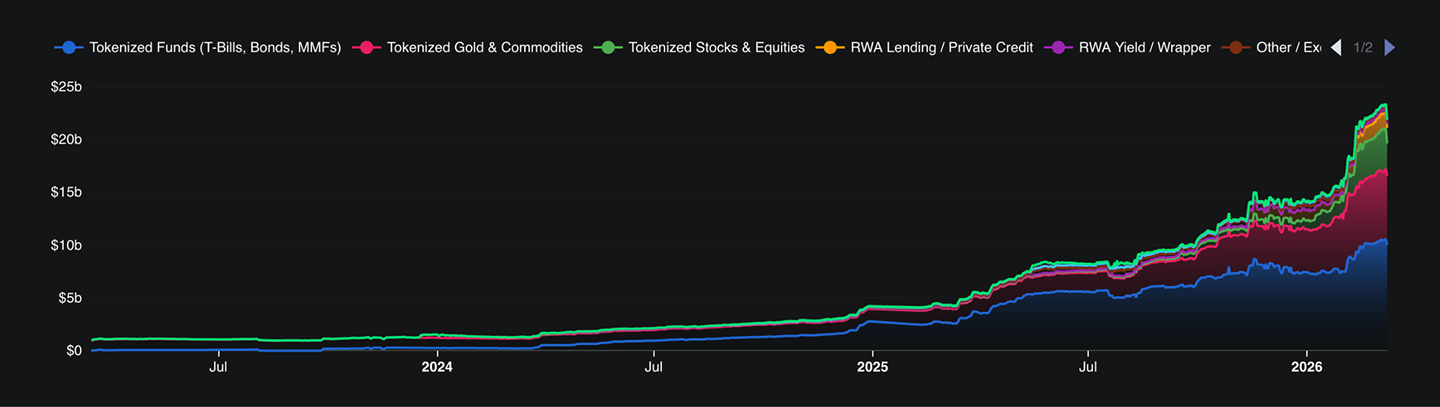
Through tokenization, institutions create a digital copy of the asset. This process enables the assets to be traded, fractionalized, and integrated into DeFi.
Unlike crypto-native assets, such as Solana or Ethereum, which derive value from network utility and market sentiment, RWAs are backed by real economic activity.
RWAs benefit from:
- Established Valuation: Centuries of historical data and legal frameworks.
- External Anchoring: Their value persists regardless of on-chain market cycles.
- Productive Yield: Many RWAs, like bonds or dividend-paying stocks, generate cash flow in the real world from tangible operations.
By bringing these assets on-chain, we enhance their liquidity.
Imagine allowing a fractional share of a building or a high-yield bond to be traded 24/7 anywhere in the world for a few cents.
Blockchains Leading RWA Adoption
The RWA industry has surged past USD 21 billion in on-chain volume. Of this amount, Ethereum, Solana, and BNB Chain account for nearly 90% of the market capitalization as of writing.
Ethereum: The Institutional Anchor
Ethereum remains the dominant force, holding more than 60% of the market share. It is the “Settlement Layer” of choice for the world’s largest financial institutions.
Trusted for its long track record of security, Ethereum hosts BlackRock’s BUIDL fund, which has crossed USD 2.3 billion in value. Institutional money, such as Wisdom Tree and Superstate stay for long-term security and interoperability with established DeFi protocols like Aave
Solana: The Retail & High-Velocity Gateway
Solana has carved out a massive niche as the high-speed retail layer, specializing in assets that require frequent movement and low costs.
The network’s speed and near-zero fees make it practical for small-scale investors and high-frequency trading.
Solana facilitates tokenized stock trading, alongside xStocks. These tokenized equities, such as Tesla, Circle, and NVIDIA, dominate the network’s top RWA assets. In addition, Solana supports a wide range of remittance use cases, including those with the remittance giant Western Union.
BNB Chain: The Middlegound
While Ethereum and Solana have dominated mindshare, BNB Chain has slowly gained adoption.
BNB Chain leverages Binance’s massive user base of over 300 million customers to become a leader in real-world assets. It has an exchange-backed ecosystem that retail users trust. That massive user base enables BNB Chain to attract institutional players.
Hashnote issued over USD 1.86 billion in USYC tokens on the network. This token represents short-term U.S. Treasury Bills, providing a stable, yield-bearing anchor for the chain’s massive retail user base.
How Traditional Assets Can Improve Blockchains
For the last few years, the narrative has been one-sided. We’ve focused on how blockchain can fix traditional finance.
By tokenizing real estate or bonds, we provided 24/7 liquidity, fractional ownership, and instant settlement. But as we move deeper into 2026, the most successful protocols are asking the reverse.
How can these tangible assets improve the blockchain itself?
The answer lies in the heart of network resilience, the staking consensus mechanism.
Current RWA Staking Models (Governance)
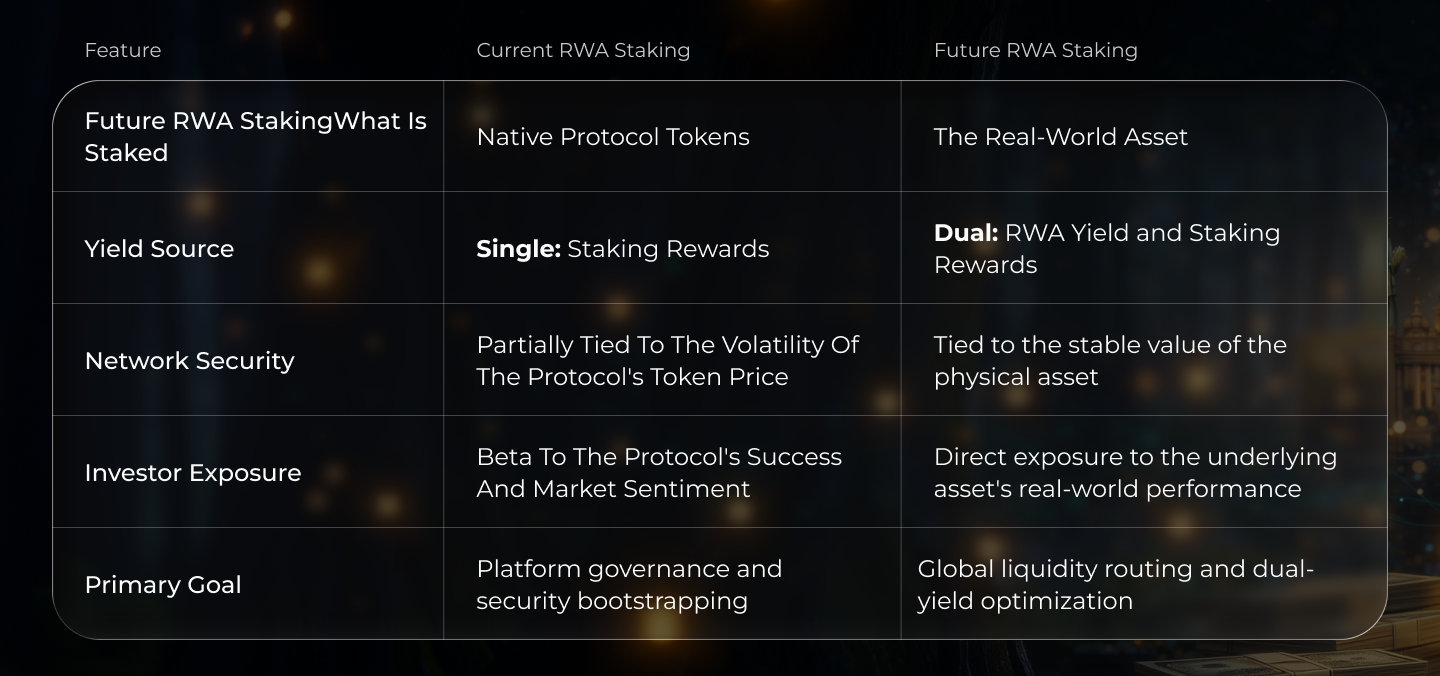
Today, “staking RWAs” refers to locking up the native governance token of an RWA-focused protocol rather than the asset itself.
Take Plume Network, a Layer 1 blockchain designed for RWAs. It operates under a Delegated Proof of Stake (DPoS) model using its native token, $PLUME.
When you stake $PLUME, you secure the infrastructure and vote on its future. While this helps the network cater to RWAs, you aren’t putting the Real World Asset to work. Your yield is tied to the token’s price and protocol staking rewards, not to the underlying productivity of RWAs such as equities or bonds.
The Future Vision of Staking the RWA
The industry’s missing piece is the ability to stake the RWA itself. This development would change the conversation from staking around an RWA to staking with the RWA.
This new model empowers you to use a fractional real estate, a US Treasury bond, or a tokenized Tesla stock to directly secure a network.
The relationship between the RWA and the protocol changes fundamentally.
In this new model, the RWA acts as direct security and primary collateral, providing an anchor for a network that persists even if the crypto market turns bearish.
Imagine a future where you own a tokenized share of a corporate building; you’re earning yield from the rentals, but because that token also helps secure a blockchain, you’re simultaneously earning yield from the network’s staking rewards.
Comparison: Governance Staking vs. Real RWA Staking
The Future of RWA Staking
The integration of Real-World Assets into blockchain staking represents more than just a new financial product. We’re looking at the maturity of the decentralized economy. By moving from governance-based staking to asset-backed staking, we are finally giving blockchains the anchor they need to withstand market volatility.
We are moving away from a world of static assets toward a future of active capital.
In this new paradigm, your portfolio doesn’t just sit in a wallet. With an RWA on hand that secured networks, you own an asset that contributes to the global economy and the decentralized world.
The protocols that successfully bridge the gap between physical value and digital security will define the next decade of finance.
Frequently Asked Questions (FAQs)
What is the main difference between current RWA staking and the future vision?
Current models typically involve staking a protocol’s native governance token. The future vision involves staking the underlying asset itself, such as a tokenized Treasury bond.
How does “Dual-Yield” work in RWA staking?
Dual-yield allows an investor to earn the organic real-world returns from an asset, such as dividends from a stock or interest from a bond. Simultaneously, they earn blockchain staking rewards for securing the network.

March 18, 2026
March 19, 2026