
Extra Yield. No Extra Risk.
Reading Time - 10 min

What the KelpDAO collapse reveals about the true cost of chasing yield.
For too long, crypto investors believed that higher yield always meant higher risk. Polli is changing that equation.
The KelpDAO Hack
On April 18, 2026, an attacker drained $292 million in rsETH, roughly 18% of the circulating supply. How?
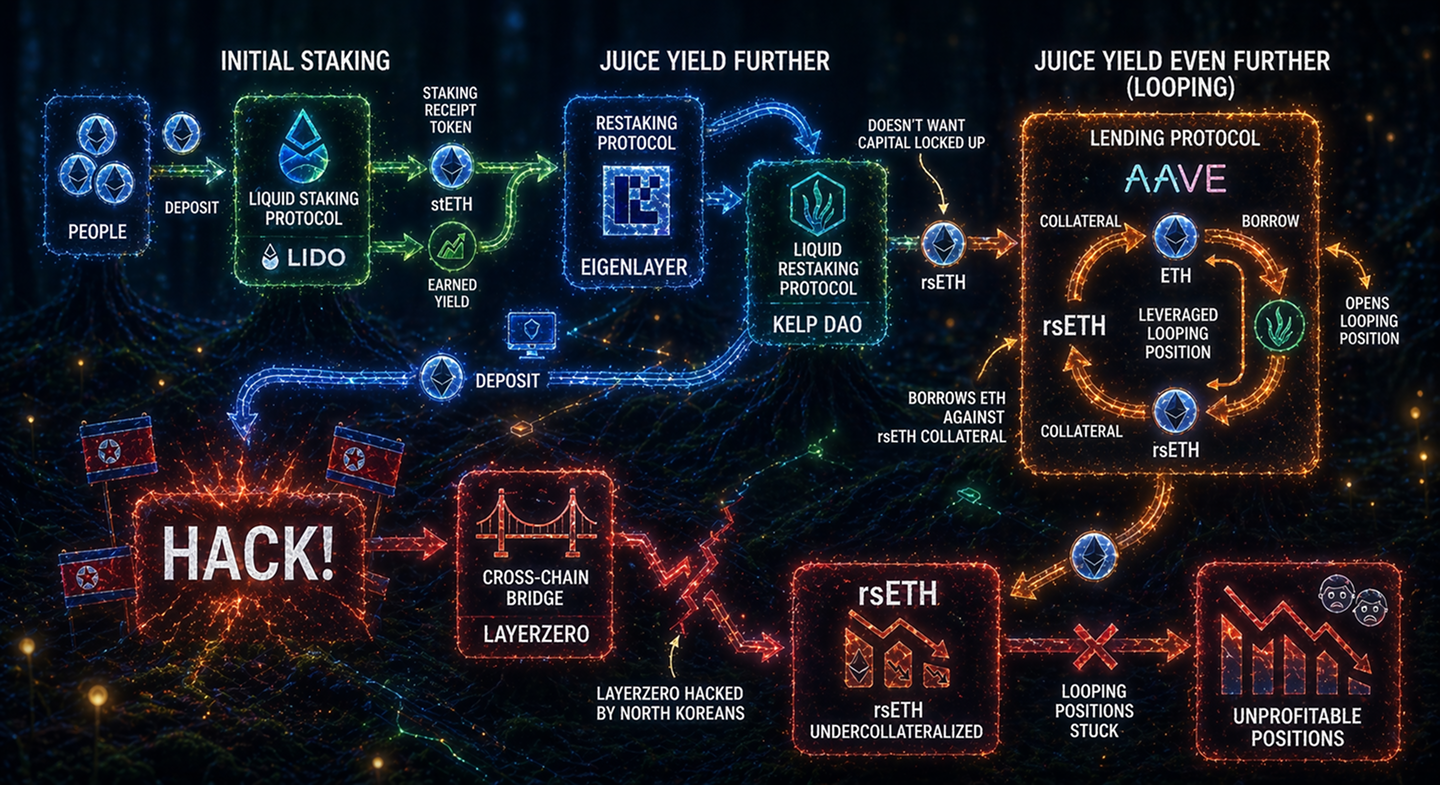
A user stakes their ETH on Ethereum to earn staking rewards. Simple enough. But their capital is locked up, so they stake through Lido instead, which hands them a liquid receipt token called stETH. Now they have yield and liquidity. Still fine. But they want more yield, so they deposit their stETH into
EigenLayer, a restaking protocol that lets them earn additional rewards by extending their stake’s security guarantees to other networks. More yield, same collateral. Getting complicated. But they still don’t want locked capital.
They use KelpDAO, a liquid restaking protocol built on top of EigenLayer, which issues them rsETH in exchange. Now they have yield from Ethereum staking, yield from restaking, and liquidity. Still with me? Because it doesn’t stop there.
With their rsETH in hand, they deposit it into Aave as collateral, borrow ETH against it, restake that ETH to earn more rsETH, deposit that rsETH as additional collateral, borrow more ETH, and loop the whole thing repeatedly. At each turn, the leverage amplifies both the yield and the exposure. The position becomes a tower of nested claims, each layer dependent on every layer beneath it.
Then LayerZero, the cross-chain bridge that rsETH relied on for pricing data, was exploited. rsETH became undercollateralized. The looping positions, the ones borrowing ETH against rsETH as collateral, became insolvent. Everyone is pointing fingers.
The staker blames KelpDAO. KelpDAO points to LayerZero. LayerZero is compromised. The borrowed ETH is stuck. The funds are largely gone. The yield that looked spectacular on a spreadsheet turns out to have been rent on risk that was never disclosed.
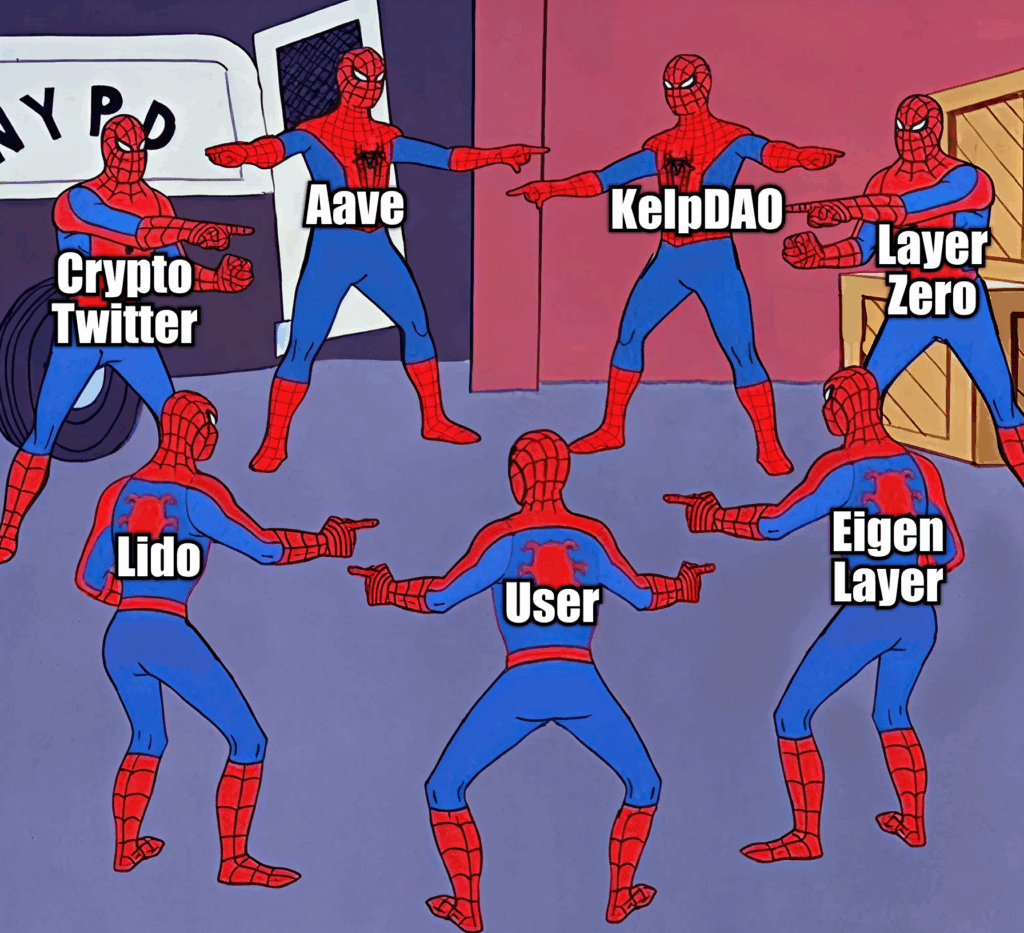
The yield was real. But so was the risk.
The tragedy here isn’t that something was hacked. Exploits happen. The tragedy is that a user who thought they were earning staking yield had, without necessarily realizing it, accumulated exposure to five distinct layers of risk:
- Ethereum validator risk: slashing, downtime, and client bugs in the base staking layer.
- Lido smart contract risk: a bug or governance failure in the liquid staking protocol.
- EigenLayer restaking risk: slashing conditions from the additional networks EigenLayer secures, including new categories of operator misconduct.
- KelpDAO protocol risk: the smart contracts managing the rsETH minting and redemption mechanism.
- Bridge and oracle risk: the LayerZero integration that KelpDAO depended on for cross-chain pricing, which turned out to be the attack surface that brought the whole structure down.
- Aave Protocol: Lending protocol, liquidation risk; looping amplifies each of those layers by the multiple of the loan.
Each individual layer probably looked manageable in isolation. Risk compounds when you stack protocols. One exploited bridge wipes out the entire tower.
Native staking, optimized
Native staking is the gold standard for security, but it often leaves yield on the table. Polli bridges this gap by maintaining the security of native staking while optimizing its efficiency through allocation intelligence.
Polli is an AI-powered allocation intelligence layer that continuously optimizes your staked positions while maintaining network health by balancing security, decentralization, and yield. It is non-custodial.
Under the hood, it uses on-chain authorization grants to act on your behalf, constantly monitoring, claiming, and compounding rewards, and redelegating to the best-performing validators, while you never give up custody of your tokens. Polli executes signed transactions you’ve pre-authorized within a specific scope and with specific spending limits. It can’t do anything outside those grants.
The mechanics of optimization
Most stakers set their delegation once and leave it. Validators drift. Commissions change. Performance degrades. The stake stays put. That static allocation is a slow, silent drain on yield that almost nobody measures.
Polli runs a different model. Every position is continuously evaluated against live network conditions.
When a better allocation exists, Polli moves. When rewards have accumulated to the point where compounding is profitable, Polli compounds.
These two functions reinforce each other: better allocation raises the base yield, and dynamic compounding ensures those gains are continuously put back to work.
The result is a position that consistently earns at or near its theoretical maximum, without any manual intervention.
The engine behind this is Polli’s proprietary validator scoring, which evaluates every validator across multiple dimensions in real time:
- Uptime and reliability: Validators that miss blocks cost you yield silently over time
- Fee structure: Commission rates directly affect net returns, and these change
- Performance trajectory: A validator declining in performance today is a drag on yield tomorrow
- MEV and reward capture: Validators vary significantly in how much total reward they return to delegators
Blockchains produce more performance data than any human operator can meaningfully track and act on in real time. Polli processes that signal continuously and acts on it, which is why it consistently generates 10 to 20% above network staking APRs.
The point isn’t the number. The point is that it comes without introducing any new risk that can drain your principal.
Security without compromise
There is no bridge. There is no liquidity token. There is no borrowed collateral. There is no leverage. There is no secondary protocol that your yield depends on the remaining solvent.
Your principal is safe for two reasons. First, Polli is non-custodial: your tokens never leave your wallet, and Polli’s authorization grants are scoped and limited. Second, there is no leverage exposure: Polli cannot borrow against your stake, issue a derivative of it, or create any obligation that puts your original position at risk.
If you’re already a staker, Polli adds yield without adding risk. That’s a precise statement. The risk profile of your position is identical to what it was before you used Polli. You’re exposed to validator risk, chain risk, and smart contract risk from the staking module itself, exactly what you were exposed to when you first staked. Polli doesn’t introduce a new protocol layer, a new token, a new bridge, or any new counterparty.
When you use Polli, the question “what happens if Polli breaks?” has a clean answer: your staked assets remain staked, in the validator you were last staked to, and your rewards remain unclaimed until you claim them manually.
Polli’s monitoring is turned off, and nothing is lost. The worst case is that optimization stops. Not that positions become insolvent.
Risk has a premium
Before depositing into anything that promises enhanced staking yield, the question to ask isn’t “What’s the APY?”
It’s: “What new risk am I taking on to earn the difference between this and plain staking?”
If the answer involves a liquidity token, a bridge, a lending market, or leverage, you’re not earning a better staking yield.
You’re earning a risk premium for something that can and occasionally does go to zero. That’s a legitimate trade for some people in some positions. But it should be a conscious trade, made with eyes open, not something buried in the mechanics of a protocol that most users never fully read.
Polli’s answer to that question is: nothing. The extra yield is earned by doing the same thing you’re already doing, just with intelligence.

April 24, 2026
April 24, 2026